KubeFlex Architecture
KubeFlex implements a sophisticated multi-tenant architecture that separates control plane management from workload execution:
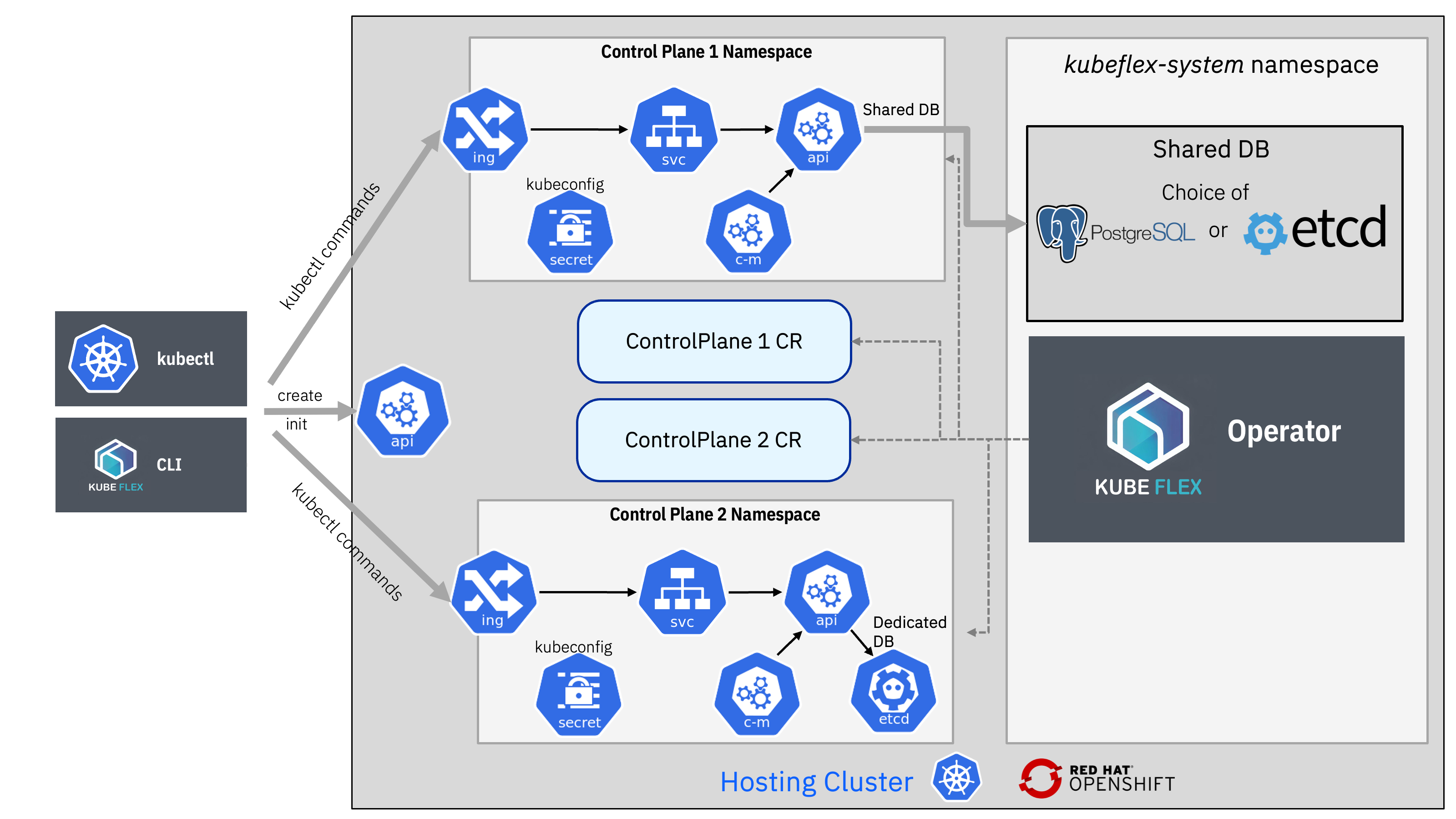
Core Components
- KubeFlex Controller: Orchestrates the lifecycle of tenant control planes through the ControlPlane CRD
- Tenant Control Planes: Isolated API server and controller manager instances per tenant
- Flexible Data Plane: Choose between shared host nodes, vCluster virtual nodes, or dedicated KubeVirt VMs
- Unified CLI (kflex): Single binary for initializing, managing, and switching between control planes
- Storage Abstraction: Configurable backends from shared Postgres to dedicated etcd
Supported Control Plane Types
KubeFlex is a flexible framework that supports various kinds of control planes, such as:
-
k8s: a basic Kubernetes API Server with a subset of kube controllers. The control plane in this context does not execute workloads, such as pods, because the controllers associated with these objects are not activated. This environment is referred to as ‘denatured’ because it lacks the typical characteristics and functionalities of a standard Kubernetes cluster It uses about 350 MB of memory per instance with a shared Postgres Database Backend.
-
vcluster: a virtual cluster that runs on the hosting cluster, based on the vCluster Project. This type of control plane can run pods using worker nodes of the hosting cluster.
-
host: the KubeFlex hosting cluster, which is exposed as a control plane.
-
external: an external cluster that is imported as a control plane (this is in the roadmap but not yet implemented)
-
ocm: a control plane that uses the multicluster-controlplane project for managing multiple clusters.
When using KubeFlex, users interact with the API server of the hosting cluster to create or delete control planes. KubeFlex defines a ControlPlane CRD that represents a Control Plane.
When a user initiates the creation of a Control Plane Custom Resource (CR) by
executing the kflex create <cp> command or the kubectl apply -f mycontrolplane.yaml
command for a control plane of type k8s, the KubeFlex controller creates a new namespace
within the hosting cluster, and then deploys the following artifacts in that namespace:
-
Deploys a Kubernetes API server instance within a pod, which serves the API for the control plane.
-
For control planes designated as type
k8s, the API server is configured to use a shared Postgres database as a backend DB. This database is located in thekubeflex-systemnamespace. KubeFlex takes advantage of kine, a tool that emulates the etcd interface for Postgres, allowing the API server to interact with the database.Note: PostgreSQL is installed using PostCreateHook Jobs rather than Helm subchart dependencies. For detailed information about this architectural decision, see PostgreSQL Architecture Decision.
-
For control planes designated as type
vcluster, the API server and an embedded etcd database run as a single process in the pod, and mount a persistent volume for etcd.
-
-
Deploys a Kubernetes controller manager within a pod in the new namespace. This controller manager operates a select group of essential Kubernetes controllers, such as namespace, garbage collection (gc), and service account controllers. The controller manager is configured to connect to the hosted Kubernetes API server.
-
Creates a Service for the Kubernetes API server
-
Creates either an Ingress or a Route for providing external connectivity to the API server. The latter is adopted if the hosting cluster is an OpenShift cluster.
-
Creates a Secret that contains the
kubeconfigfile required by clients to access the Control Plane API server. The secret has actually two Kubeconfigs, for off-cluster access and for in-cluster access. The latter is used by clients running in the hosting cluster, such as controllers.
This flow might be slightly different for other types of control planes, such as
vcluster or host, but there are common elements for each type:
-
A namespace with the name of the control plane and the
-systemsuffix -
A secret with the Kubeconfigs for in-cluster and off-cluster access. For clusters of type
hostthe in-cluster Kubeconfig is available, -
A service to connect to the hosted API server
-
A route or ingress to connect to the hosted API server
The last two elements are not present for ControlPlanes of type host and external.